Exercise and Fertility:
What It Means for Men & Women
Published on October 7, 2026
Written by Kathleen Morrison
Medically Reviewed by Andrea Sleeth WHNP-BC, MSCP, a healthcare provider affiliated with Wisp
Key takeaways
- Regular physical activity can help support good preconception health. Whether it directly changes your odds of conceiving is a murkier question.
- Moderate exercise is generally compatible with reproductive health, and more is not automatically better for everybody.
- Very high training loads paired with not eating enough may disrupt the menstrual cycle and ovulation in some women.
- In men, structured exercise may help support sperm quality measures, though evidence that it changes the odds of fathering a child is less established.
- There is no FDA-approved "exercise treatment" for infertility. Exercise is a lifestyle habit, not a fertility therapy.
- No universal hour limit exists for exercise while trying to conceive. Your body, your labs, and your in-person provider’s input matter more than a number.
How many times have you Googled "does exercise improve fertility" and read things that completely contradict?
The thing is, moderate physical activity is generally compatible with reproductive health, while very high training volumes paired with under-eating can disrupt ovulation in some women. Where you land depends on a lot more than hours logged.
That "depends" is doing heavy lifting, so let's get into it, and if you'd rather see real data about your own cycle than guess, at-home fertility testing is a reasonable place to start.
These statements have not been evaluated by the Food and Drug Administration. This product is not intended to diagnose, treat, cure, or prevent any disease. Individual results may vary.
How exercise affects fertility
Quick vocabulary note, because it'll come up a lot: researchers use the word fecundability, which just means your chance of conceiving in any given cycle.
Not a yes-or-no thing. A dial.
And that dial doesn't move in one direction with exercise. A group of researchers followed thousands of women who were trying to conceive and found that the ones doing a lot of really hard exercise may have lower odds each cycle, while moderate movers may have slightly better than average.
Then a similar study in North America found the pattern flipped depending on body size.
So ultimately, how exercise affects fertility depends on how much, how hard, how much you're eating, your body composition, and whatever else is going on underneath.
Exercise and fertility in females: Where the line sits
Female fertility runs on a conversation between your brain and your ovaries, and that conversation pays close attention to how much energy you have spare.
For most women, a consistent, well-fueled routine is generally compatible with conceiving.
Exercise and cycle regulation
A predictable menstrual cycle can be one of the clearest signs your hormones are doing their job.
Things get complicated at the far end of the effort scale. Train very hard without eating enough to cover it, and your brain can quietly turn down the signals that drive ovulation.
Sports medicine calls this low energy availability, a technical way of saying your body is running a deficit and starts cutting non-essential spending. Reproduction, annoyingly, is on that list.
It can show up as:
- Periods that get lighter or irregular
- Cycles where no egg is released
- Periods that stop altogether
- Weaker bones over time
Note what the actual problem is: not the exercise, but the gap between what you burn and what you eat. Which matters, because "stop working out" is not the best advice and "support your body with nutrition and recovery" may help.
Exercise, weight, and insulin
Body weight shows up at both ends of this conversation: very low and elevated weight can each disrupt the hormone signals behind ovulation.
For overweight and obese women dealing with fertility issues, ASRM says lifestyle changes combining diet and physical activity may improve some outcomes, ovulation especially.
Body size also changes the whole equation. In a study, vigorous exercise was linked to better odds among overweight and obese women; the opposite of what showed up in leaner participants.
Same activity, different bodies, different result.
Also, know that physical activity may play a helpful part in managing PMOS and fertility. But it's not a cure for PMOS, and it isn't a substitute for fertility treatment when that's what you need.
Exercise and stress
Stress isn't just a vibe; it can impact hormonal balance. A study measured a stress marker in women's saliva while they were trying to conceive, and higher levels may be linked to lower odds of conceiving each cycle.
Exercise sits on both sides of that. It may take stress off you, or pile more on, depending on the day and the dose. There's no single right workout dose for this, and anyone offering you one is guessing.
What you can do is a gut check: does your routine leave you energized, or wiped? If your sessions leave you exhausted, snappy, and sleeping badly, they're probably adding to the pile.
Does exercise help if you're in fertility treatment?
It might help a little, but don't expect a magic bullet. The research here is limited and a bit of a mixed bag.
One group of researchers pooled results from a dozen studies covering thousands of women going through IVF and similar treatments. Here's what they found:
- Clinical pregnancy: Women who were more physically active had a significantly better chance of getting pregnant.
- Live birth and miscarriage: There was no clear link between activity level and whether women had a baby or a miscarriage.
Other research has reached similarly mixed conclusions.
So, if exercise feels good, keep doing it. It may give you a small boost, and it's good for you anyway. Just don't put pressure on your workouts to carry your whole treatment plan.
Exercise and fertility in males: The half nobody talks about
Exercise and fertility for men gets discussed far less, which is a shame, because there's more research here than you'd expect.
Exercise and sperm quality
Structured exercise programs have been studied in relation to sperm parameters.
That's encouraging, but it's also not the same as "exercise treats male infertility," because these studies mostly counted sperm, not babies.
That difference is worth knowing before you build a training plan around it.
Exercise and hormonal balance
Testosterone is the main reproductive hormone in men, and it sets up the conditions sperm production depends on.
The broad pattern is that steady, moderate training may help with reproductive hormone markers better than either sitting still or going extremely hard.
What that doesn't give you is a prescription. There's no proven protocol for training your way to better hormones, and these studies weren't designed to build one.
If you're training at a high level while trying to conceive, the more useful conversation is with an in-person provider about your whole picture.
Finding exercise balance when trying to conceive
Both partners benefit from thinking about this, not just the person carrying the pregnancy. Adjusting early can give your body time to respond.
Guidelines for moderate exercise
Federal Physical Activity Guidelines suggest roughly 150 to 300 minutes of moderate aerobic exercise a week, or 75 to 150 minutes of vigorous activity, plus strengthening work on at least two days.
Two things to be clear about:
- These are general health guidelines for everyone, not a fertility protocol
- "Moderate" means you can hold a conversation, but wouldn't want to sing
The benefits of exercise at this level are well established for your overall health. That's reason enough on its own, whatever it does or doesn't do to your odds.
How much exercise is too much when trying to conceive?
There's no universal cutoff. Tolerance varies with body composition, nutrition, training history, and whatever else is happening hormonally.
So stop counting hours and watch the signs above instead.
Signs your training may be affecting your reproductive health include:
- Irregular, very light, or missing periods
- Low libido
- Fatigue that sleep doesn't fix
- Sleep that's suddenly unreliable
- Recovery taking longer and longer
These aren't things to push through. They're data, and tracking data alongside your cycle gives you something concrete to bring to an in-person provider.
Rest and recovery matter as much as the workouts
Recovery isn't a break from your routine. It's part of it.
Sleep and rest days are when your body does its repair work, and consistently skipping them tends to catch up with you: in your training, your mood, and your patience for any of this.
So build them in. If your calendar has room for five workouts but not eight hours of sleep, reconsider before adding a sixth.
Your fitness tracker can't tell you about your fertility status
Exercise is part of the bigger picture. For both men and women, regular, moderate activity can help support overall health and may be beneficial for reproductive health, too.
But exercise isn't a fertility treatment, and more isn't necessarily better. Keep moving, but don't expect your workout routine to answer questions it wasn't designed to answer.
Your fitness tracker counts your steps, your heart rate, your sleep debt. What it can't tell you is whether an egg was released this cycle, or what your partner's numbers look like.
And sometimes, that's the information you actually need. Instead of endlessly adjusting your workouts based on how you feel, at-home fertility testing can help give you a clearer starting point.
The Wisp Fertility Starter Kit makes it possible to test at home for both partners, giving you fertility information to bring to an in-person provider, and letting your workouts get back to what they do best: keeping you moving.
This blog post is for informational and educational purposes only and should not be taken as professional advice. Always consult with a qualified professional before making any decisions based on the information provided here.
Trusted Treatments
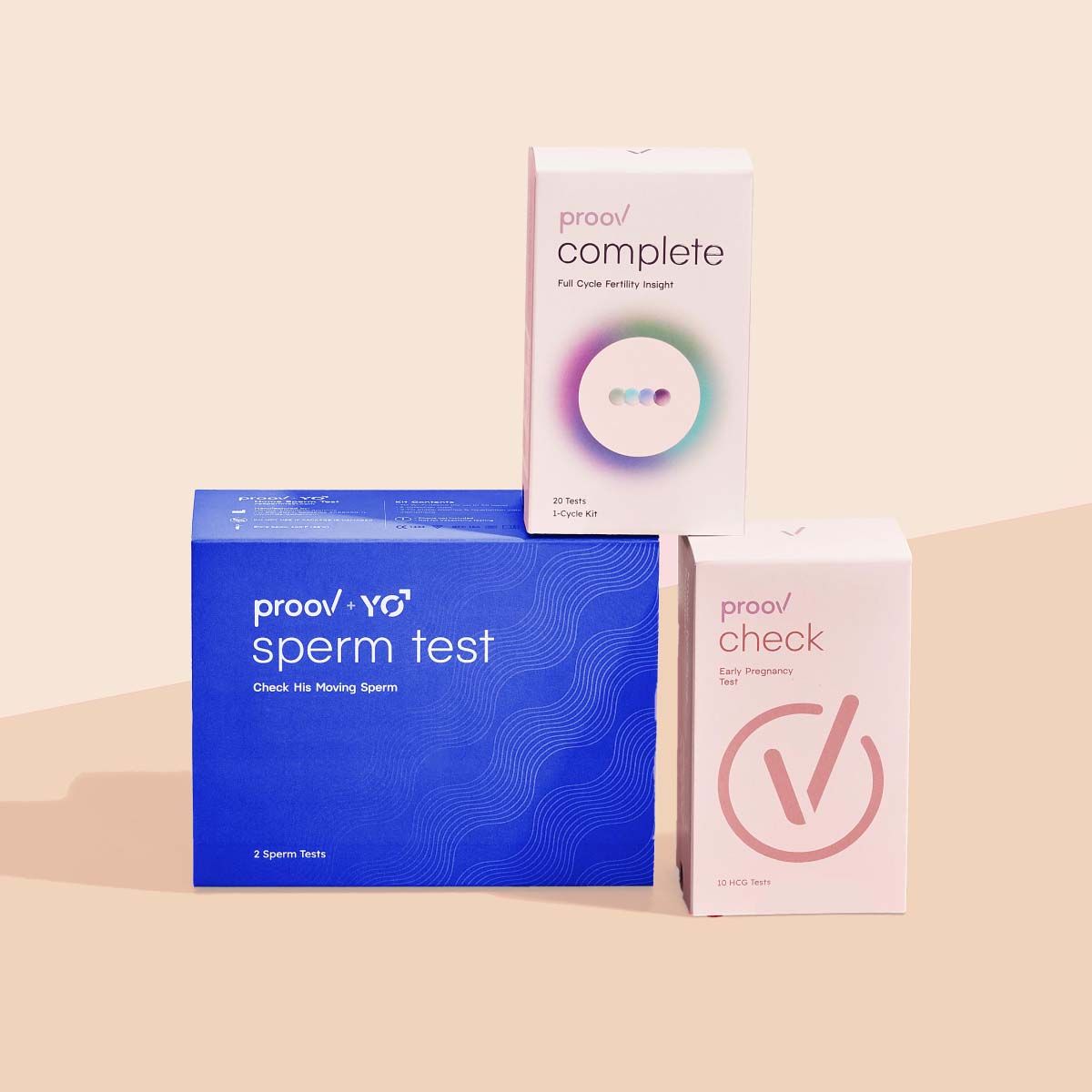
Hers & His Advanced Fertility Kit by Proov
$169.99
The only all-in-one fertility test kit for couples that covers both male and female testing